Bharat is still in Beta, beta
9 min readessayEntrepreneurship
I collected and studied 2,000+ startup ideas so you don’t have to
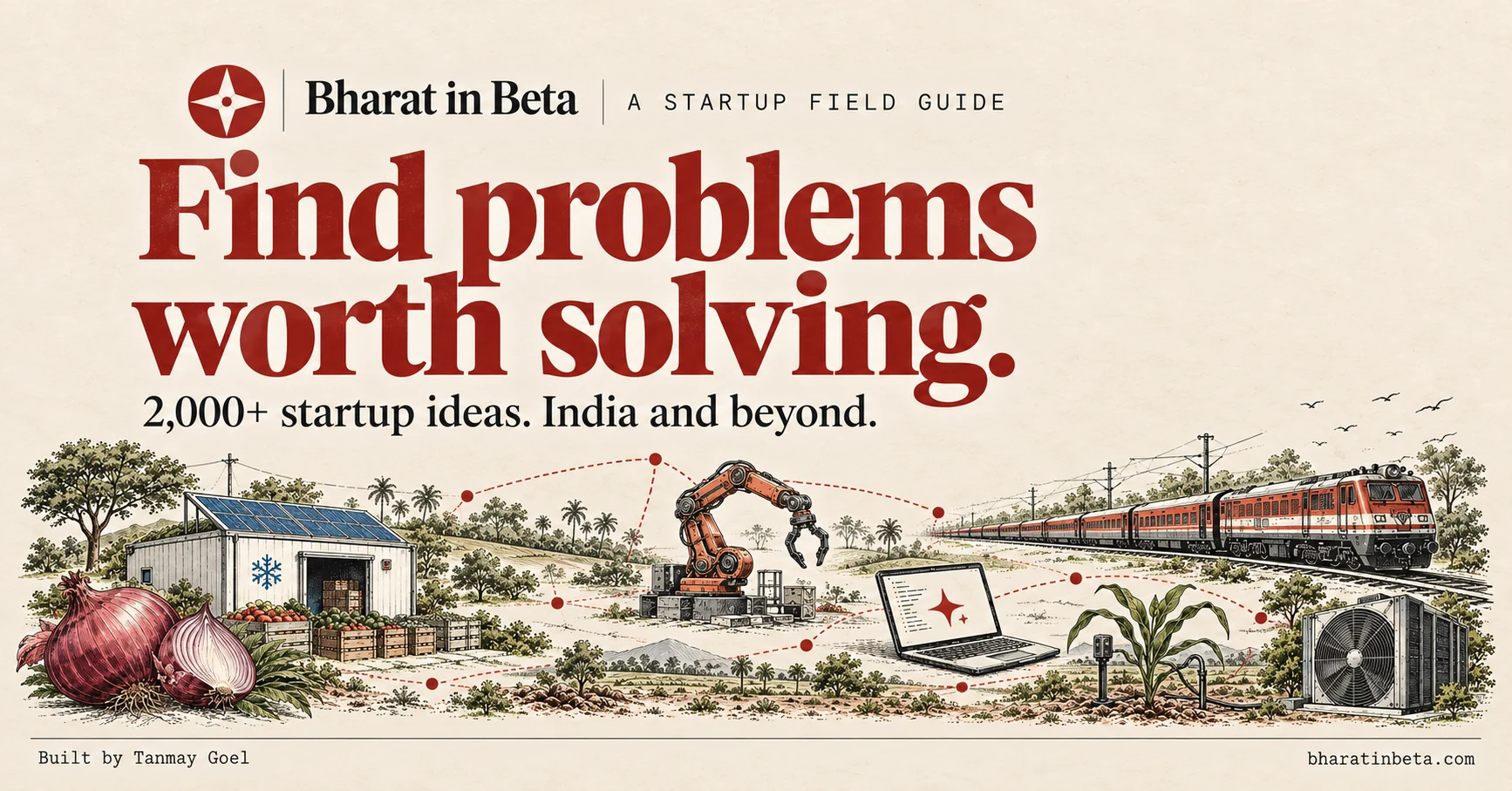
I’ve always loved reading these “requests for startups” posts by VCs and angels. Over the past few months, I started collecting them and looking for patterns. What are people excited about? What kinds of companies do they want to fund? What problems keep coming up?
I found a lot. AI doing office work. Robots in smaller factories. Better ways to store food. Healthcare, learning, clothing, water, aircraft maintenance. Even floating data centres.
There’s still a lot of fun to be had. There is still a lot to be built.
For any budding founder, wanting to take the plunge but feel that every industry is saturated, this is for you. Seeing someone already working on a problem can give you more to investigate: what have they figured out, who are they serving, and what still needs to get better?
There are many ways to build a useful company. A problem in a world you already understand could give you somewhere to start.
I put it all in one place
I got so excited by these ideas that I decided to consolidate them into an idea atlas.
I call it Bharat in Beta.
The work started with collecting the sources and organising the individual ideas. Some were specific requests. Others were broader investment themes, research directions or examples of companies already building something interesting.
I wanted to make it easy to move between them. Find an idea, understand what it means, follow the source, then see what else is nearby.
So each entry keeps its original source and date. The analysis sits alongside it, with possible starting points and questions to explore. Similar ideas from different sources stay separate, so you can see how different people approach the same space.
You can:
- Browse by theme, source, year and type of idea.
- Follow an entry back to where it came from.
- Read analysis and starting points for more than 600 entries.
- Explore longer articles connecting ideas and what they could mean for India.
There are AI and non-AI ideas. Some could start as a small service business. Others involve laboratories, factories or serious infrastructure. You can wander through the whole thing or begin with a field you know.
Who is this for?
If you’re exploring what to build, this gives you places to look. If you already work in an industry, you might recognise a problem you’ve been dealing with for years.
Students can use it to find something interesting to learn or build a project around. Founders can explore adjacent problems. Investors and curious readers can compare what different sources are paying attention to.
I’d like someone to open it, follow a few links and think, “Hang on. I know something about this.”
Patterns, Patterns, Patterns
Here are seven themes running through the collection, with five examples each. These mix published requests, investment themes and existing businesses. They show different ways people are approaching a problem.
1. AI is getting a job description
There are requests for AI to deliver services, learn how a company works and help teams get things finished. That makes the work itself interesting: the documents, follow-ups, handovers and exceptions someone currently handles.
If you already do that job, you know where to start asking questions.
- Deliver a finished service. Use software and people to take responsibility for completing the work. Source: Z47.
- Interview a company to understand how it works. Capture knowledge from employees so staff and AI agents can use it. Source: Pear.
- Let a team work with the same AI agent. Colleagues can watch, redirect and hand off a shared session. Source: YC.
- Handle jobs too small to outsource. Take on narrow tasks such as chasing documents or resolving invoice exceptions. Source: Stellaris.
- Get construction permits through the process. PermitFlow is an existing example of organising the research, forms and follow-up. Source: Felicis.
2. The physical world needs an upgrade
AI needs power, cooling and equipment that keeps working. Factories need machinery suited to their budgets and the jobs they actually do. Robots need someone to make them useful at a particular site.
There is room here for people who understand manufacturing, engineering, materials and maintenance.
- Cool AI computing equipment. Develop cooling systems for powerful AI servers. Source: Bessemer.
- Make robots practical for smaller factories. Develop affordable, modular automation for Indian manufacturers. Source: Speciale Invest.
- Help robots work reliably at a real site. Adjust cameras, models and equipment to the task, then learn from failures. Source: Stellaris.
- Build more of the electronics supply chain in India. Explore components, design and semiconductor-related inputs. Source: Avataar Ventures.
- Help clothing brands manufacture smaller batches. Flexible production can help brands make products without committing to huge orders; the source discusses Thimblerr. Source: 3one4 Capital.
3. There’s a whole business around the farm
Growing something is one part of the job. Then come processing, storage, water, weather risks and finding useful things to make from agricultural materials.
Some of these examples are already businesses. They’re useful to study because they show how specific the work can be.
- Process food closer to the farm. Put food-processing equipment closer to the farms growing the produce. Source: ThinkAg.
- Make textile inputs from agricultural fibres. STCH is an existing example using agricultural fibres to develop textile materials. Source: Omnivore.
- Use weather data for smallholder insurance. IBISA is an example using environmental data to cover weather-related risks. Source: Ankur Capital.
- Supply water as a service. Uravu’s work includes pilots supplying water to beverage producers. Source: Speciale Invest.
- Keep produce at the right temperature. Use materials that store and release heat to manage temperature. Source: ThinkAg.
4. Daily life is full of product briefs
The collection also gets very familiar. What should we cook? Who is following up with the repair technician? Can this snack taste good and still be affordable?
These ideas involve routines, preferences and trust. Knowing how people actually live gives you something useful to work with.
- Sort out what to cook today. Coordinate household preferences, ingredients, leftovers and instructions for the cook. Source: The Ken.
- Keep household appliances running. Organise service histories, technician visits and follow-ups. Source: The Ken.
- Make healthier snacks people can afford. Compete on taste and price as well as nutrition. Source: Fireside Ventures.
- Make clothes for particular occasions. Outzidr is an existing example of testing designs in small batches and responding to what sells. Source: Stellaris.
- Build a travel brand for older people. Explore luxury group trips for seniors. Source: Fireside Ventures and Redseer.
5. Care has a lot of moving parts
Healthcare ideas range from helping a family organise care to investigating new medicines. They need very different kinds of knowledge, but there are problems to explore throughout the process.
- Bring pain-care services together. Coordinate specialist care, physiotherapy and psychological support. Source: Endiya Partners.
- Make pain care accessible remotely. Explore teleconsultation and monitoring to help people reach care. Source: Endiya Partners.
- Make technology easier for older people. Build simpler voice tools and software that helps families coordinate daily care. Source: YC.
- Help researchers choose molecules to test. Use models to focus laboratory work on promising candidates. Source: Bessemer.
- Explore better targeting and delivery for antibody therapies. Use computers to design candidates, then test them in the lab. Source: DCVC.
6. Learning by doing is getting new tools
Some requests ask what learning could look like when a product responds to the person using it. Others focus on learning a practical skill while doing the work.
There are interesting questions here for teachers, trainers and people who enjoy making things.
- Teach children the basics with an adaptive tutor. Start with reading, writing and arithmetic, adjusting the lessons to the child. Source: YC.
- Let children describe a game and build it. Help them learn logic, design and coding as they create. Source: Pear.
- Guide someone through a physical task. Explore visual and spoken help for technicians and other workers. Source: YC.
- Train more people for skilled trades. Explore AI instruction for electricians, cooling-system technicians, welders and other workers. Source: YC.
- Build tools for teaching and assessment. Help teachers and learners while accounting for tight budgets and slow purchasing decisions. Source: YC.
7. The government has needs too - surprising
Public challenges can get wonderfully specific. They name a department, a piece of equipment, a place or a process that needs attention.
Some published requests in the collection ask people to:
- Help technicians inspect aircraft. Use visual guidance and remote-expert assistance during pre-flight checks of Do-228 aircraft. Source: iDEX.
- Get railway maintenance teams on the same schedule. Coordinate repair windows across track, signalling and electrical work. Source: Smart India Hackathon / Ministry of Railways.
- Keep vegetables cold despite unreliable electricity. Build small solar-powered cold stores with battery backup for rural and hilly North Eastern areas. Source: Smart India Hackathon / Ministry of Development of North Eastern Region.
- Grade onions from photographs. Assess visible rot, damage and sprouting, then produce a quality report. Source: Smart India Hackathon / Ministry of Consumer Affairs, Food & Public Distribution.
- Treat and monitor water in hard-to-serve places. Explore portable treatment and monitoring for rural and mining-affected communities. Source: Smart India Hackathon / Government of Jharkhand.
Onions deserve good software too.
Localization and Internationalization
The India context is already written into some of those briefs. A cold store in a hilly area with unreliable electricity has a particular set of requirements. So does maintaining a railway while trains still need to run.
That’s why local knowledge matters. You need to understand how the work happens, who will use the product and how it will stay useful after someone installs it.
An idea from the US arrives with a different set of assumptions. A pitch about saving expensive employee time may need to change when an Indian customer already gets that work done cheaply. Perhaps the value is serving more customers, getting paid sooner or avoiding lost orders. Which of those matters enough to pay for?
And we can build from India for customers elsewhere. The service-business ideas are one place to explore that. Someone who already understands an overseas client’s work may know exactly which documents arrive late, where mistakes happen and what requires a person’s judgement.
There are different ways to begin. The details of the customer and the work should shape what gets built.
What’s next for BiB?
I want BiB to be the one-stop-shop for everything startup related for Indian founders. I plan to keep adding useful sources and building out the analysis. There’s plenty left to explore in the collection itself.
I also want to add:
- Essays that connect ideas across themes and track how they change over time.
- Founder resources: books, podcasts, accelerators and VC firms worth knowing about.
- An idea matcher that helps people find relevant problems based on their experience and interests.
The Atlas gives us somewhere to start. Over time, I’d like this to become a home for learning about what people could build in India, and what Indian founders could build for the world.
What I hope comes out of this
I’d love for someone to spend time here, find a problem they care about and eventually build a company around it. That’s the hope: inspire the next generation of entrepreneurs by helping them see somewhere they could begin.
A published request or an investor’s interest gives you something to investigate. You still need to find the people who want the solution and work out how to deliver it.
But if the feeling that “everything has already been built” is holding you back, have a look around. Bring what you know. Find something that makes you curious enough to go deeper.
Bharat is still in Beta, beta.