Everyone should start giving a shit about government tech
11 min readessayTechnology & AI
Soo, I recently watched Varun Mayya's Build What Moves India video, where ten finalists pitched ways to make public services easier to use. It was well organised, well produced, and almost ran like a Shark Tank episode. The incentives were good - a MacBook, a trip to SF, etc. Varun cared about this, and it showed. And so it hit the mainstream.
The first five pitches were:
-
Samarthan: help people report cyberfraud through voice or WhatsApp.
-
RaktKhoj: help people find nearby blood banks and potential donors.
-
Nagarik: make municipal contacts, tenders and spending easier to find.
-
Atithi: make eVisa applications more understandable, including passport and photo requirements.
-
Ek Naksha: bring land records and ownership information into a navigable map.

Watch: We Challenged 10 Engineers to Fix India’s Government Websites. Source: Varun Mayya.
These were prototypes, with some official interactions simulated. But the brief gave people useful problems, and I wanted to know what it would take for work like this to reach the services we use.
I like seeing builders given tools, mentors and proper incentives. Varun is even trying to get government decision-makers to look at the results. This is already more than most have done.
Public tech infrastructure is kind of like... a public restroom. It's there for a good reason, we need them. But you want to avoid using it, unless absolutely necessary. And it's never a good experience.
Now that I think of it, most public things are the same. But should they be? Public restrooms can be pretty and useful. Look at Japan.

Public toilet design in Japan. Source: Time Out.
This sent me down a rabbit hole into our own systems. India has people who can build, increasingly accessible tools, and some very good public technology already. Why are so many everyday services still difficult?
I just want to finish the damn filing!!!!
For about a month, I haven't been able to complete a filing on the MCA portal. I keep ending up in a loop of errors, instructions and another attempt. The support ticket has been reopened 4–5 times. I genuinely don't know what to do next.
I can't tell whether I've done something wrong, whether the website has failed, or whether another part of the process is waiting for something nobody has explained. I would be much more patient with a delay I could understand. At least then I'd know what I was waiting for. My passport renewal experience hasn't been great either.
When I lost my driving licence, the route I found seemed to involve visiting an office and paying an advocate. Even after submitting a lost-licence report, I haven't received the licence or understood whether it was ever sent. Then there's the OTP that never arrives, leaving you staring at a page you can't get past.
I have plenty of resources and technological literacy. I admit that. I still struggle loads.
How does someone with less time, less confidence or nobody to ask manage this? Being good at troubleshooting software should not be a requirement for dealing with the government.
In India we get complacent with inefficiencies. If a pothole appears, we find creative ways to go around it, rather than have it fixed. Our public tech infrastructure has many potholes. Some of them prevent access to very important services.
These services handle healthcare, taxes, provident funds, identity documents and running a business. Taking my compliance to a competitor is, unfortunately, not an option. Having no alternative should make us more demanding about the design. People will keep trying because they have to; their persistence doesn't tell us the product works well.
So many of us have a phone and internet now. Why is it still so hard to do things?
Here are some stats for you nerds.
An NSO survey in early 2025 found that 85.5% of Indian households had at least one smartphone and 86.3% had internet access at home. Far more people now have a reason to expect the government to be accessible through their phone.
Here are the ten leading domains in Semrush's India government category for August 2026:
| Website | What people use it for | Estimated visits from India |
|---|---|---|
| uidai.gov.in | Aadhaar identity services | 50.76 million |
| eci.gov.in | Voter and election information | 32.93 million |
| parivahan.gov.in | Driving licences and vehicle services | 28.75 million |
| epfindia.gov.in | Provident fund and pension services | 27.72 million |
| indiapost.gov.in | Postal services and tracking | 24.68 million |
| incometax.gov.in | Tax returns, payments and records | 23.80 million |
| wb.gov.in | West Bengal information and services | 20.80 million |
| rajasthan.gov.in | Rajasthan information and services | 19.66 million |
| karnataka.gov.in | Karnataka information and services | 18.47 million |
| bihar.gov.in | Bihar information and services | 17.65 million |
Estimated website visits, including repeats, rather than unique people. Apps are excluded; the category isn't exhaustive. State domains cover several services.
India does government on its phone
Estimated visits from India to the ten most-visited government websites, split by device.
About 168 million of the 265 million estimated visits to these ten sites came from mobile. Only two of the ten get more of their traffic from computers.
- uidai.gov.inAadhaar identity50.8
- eci.gov.inVoters and elections32.9
- parivahan.gov.inLicences and vehicles28.8
- epfindia.gov.inProvident fund, pension27.7
- indiapost.gov.inPost and parcel tracking24.7Most phone-heavy
- incometax.gov.inTax returns and payments23.8Computers lead
- wb.gov.inWest Bengal state portal20.8
- rajasthan.gov.inRajasthan state portal19.7
- karnataka.gov.inKarnataka state portal18.5
- bihar.gov.inBihar state portal17.7Computers lead
These numbers would give any B2C or B2B startup founder or VC a little happy flutter down there.
So a lot of people CAN reach these websites, and ARE using them. How many actually finish what they came to do?
The road to hell is paved with good intentions
We (my AI research bot and I) combed through public app reviews, Reddit discussions, official FAQs and government reporting, grouping the examples into ten types of friction. These are reported problems, rather than a national ranking of complaint frequency. They span apps, websites and administrative or physical processes; historical issues may have been fixed.
| Problem | What the person reports | An example source |
|---|---|---|
| OTP delivery or expiry | Verification fails before they can continue | mParivahan reviews |
| Login or session failures | They can't get in or remain in the service | EPFO discussion |
| Slow or unavailable pages | Loading never completes or access fails | UMANG reviews |
| Document or signature validation | An upload is rejected without a useful route forward | MCA FiLLiP discussion |
| Missing or mismatched records | Saved documents or details can't be retrieved correctly | DigiLocker reviews |
| Payment and confirmation | Money is paid but the next task remains incomplete | Tax-payment discussion |
| Unclear progress | Submitted status doesn't explain the next step | Voter-application discussion |
| Ineffective support | Following the advice doesn't solve the problem | mParivahan reviews |
| Device security blocks | A user says their ordinary phone is blocked | ABHA reviews |
| Digital-to-physical handoff | Online registration leaves the physical queue unchanged | ABHA reviews |
Some accounts describe people clearing caches and reinstalling without success. Others include recovery: the taxpayer above eventually completed the return by entering the challan details after a successful payment and failed redirect. An IRCTC reviewer reported a refund after a failed booking. An ABHA reviewer obtained a digital token and still spent two to three hours in a hospital queue.
Where the journey breaks
Every service is a trip from “log in” to “got it”. People report getting stuck at every stop, not just the login screen. EPFO means at least one public report about that service.
- 1
Get in
- Login or session dropsDigiLockermParivahanUMANGIRCTCEPFO
- Slow, crashing or downUMANGIRCTCEPFOIncome Tax
- OTP fails or expiresmParivahanEPFO
- Normal phone flagged as unsafeABHA
- 2
Hand over details
- Records missing or names don't matchDigiLockermParivahan
- Document or signature rejectedMCA
- 3
Pay
- Money debited, task still not doneIRCTCIncome Tax
- 4
Wait
- No useful status or timelineUMANGEPFOVoter IDAadhaar
- 5
Get the service
- Digital token, same physical queueABHA
Detour at any stop: ask for help
- Unreachable, or the advice (clear cache, reinstall) didn't fix itDigiLockermParivahanUMANGAadhaar
Government reporting already lets us examine different outcomes. The September 2026 CPGRAMS report recorded 111,794 online and call-centre feedback responses. Of those, 63,053 said the grievance was not resolved. Among those who said it was resolved, about 81% were satisfied. This is a feedback sample, not a representative measure of every citizen's experience.
35% or 81%? Both are true.
39,436 people said their complaint was resolved and they were satisfied. Whether that sounds good or bad depends on what you divide by.
How 111,794 pieces of feedback narrow down
The other 63,053 (56%) said their complaint was not resolved.
Next time you see a success rate, ask: out of what?
MCA reported approximately 98% successful resolution of helpdesk tickets in the period covered by its February 2026 release. Tickets included technical, awareness and processing matters. I'd like that followed through to whether people could complete their filings. My own problem remains unresolved, with a cause I don't understand. My ticket has been marked resolved four times, and I'm still stuck. So I don't take that figure at face value. I want to know whether resolved tickets meant completed filings.
But we have also crushed it?
This is why I find the situation difficult to accept. India has already made complicated processes much easier.
UPI shows what public infrastructure, banks and private products can do together. DigiLocker makes issued documents available digitally. Jeevan Pramaan gives pensioners a way to submit a digital life certificate. They have their own problems, including some in the reviews above, but they show that services requiring considerable physical effort can change.
With something like Blinkit, you can choose what you need, pay, track the order and find help.
I find it a little ridiculous that so much thought can go into helping someone follow their groceries, while a government application leaves them wondering whether anything happened at all.
Government services have different obligations, a more varied audience and systems they can't casually replace. I understand that. I would still expect clear instructions, saved progress and an explanation of what happens next, especially when someone's money, health or ability to run a business is involved.
Why don't we run these like startups?
I hate to say it, but the US government is cooking. (In many ways, no. In their tech transformation, yes.) Experienced product people are being brought into these services. Airbnb co-founder Joe Gebbia leads the National Design Studio, with people who have worked at Apple, Google and Airbnb.
America.gov launched in September as an AI-enhanced entry point to information across more than 29,000 government websites.
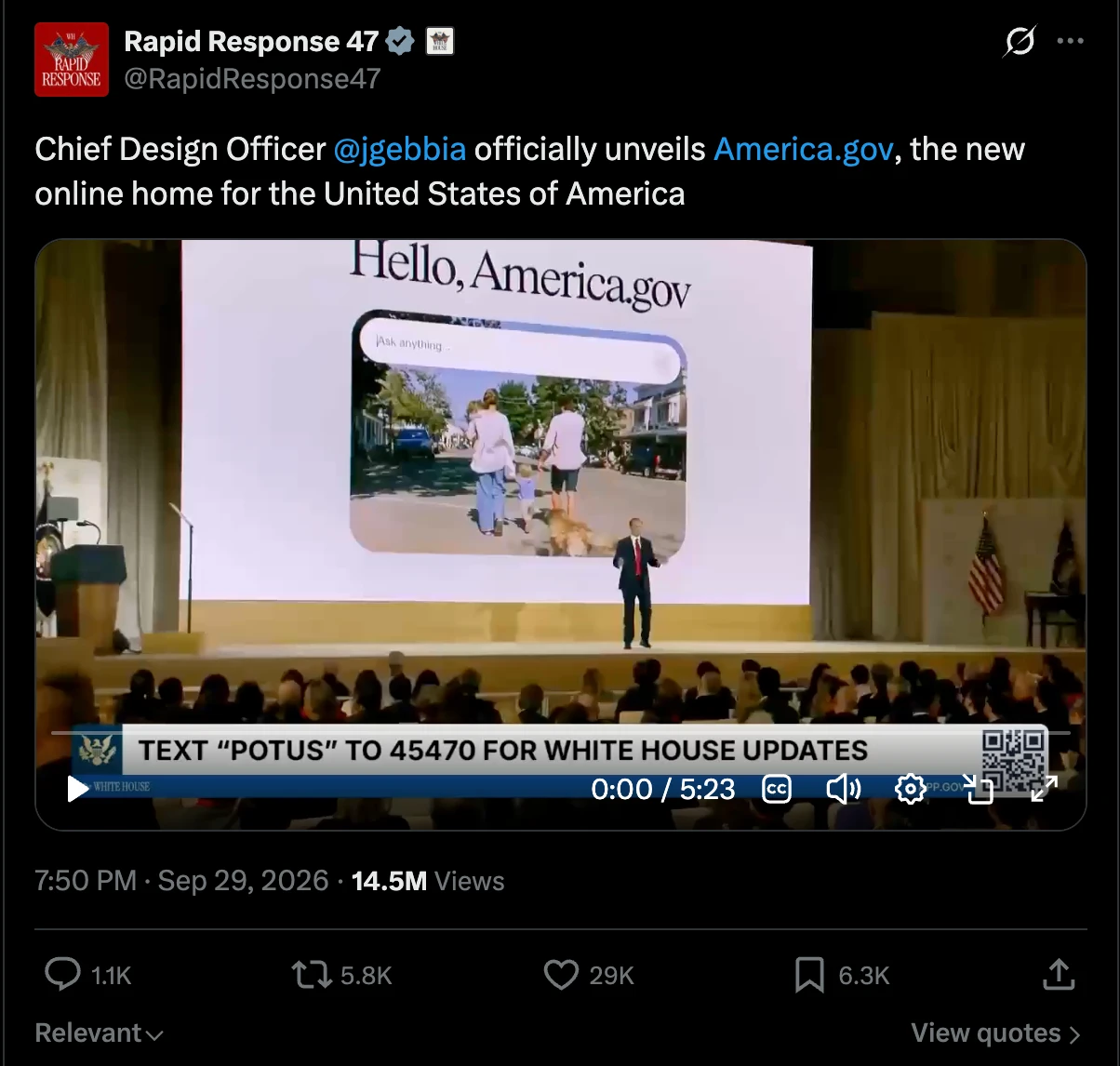
Joe Gebbia unveils America.gov. Source: Rapid Response 47.
They've previewed a digital passport application experience, with Login.gov, phone photos and tracking. Broader availability is planned; the underlying services haven't all been rebuilt. Earlier work on online passport renewal reduced estimated application completion time from forty minutes on paper to ten minutes online. That's time spent applying, rather than waiting for a passport.
Gumroad founder Sahil Lavingia now works on digital products at the IRS, which launched a new mobile app in September, including account information, payments, records, notices and refund status. He has also asked people what the IRS should ship next. I'd like more people building government products to invite specific feedback like that.
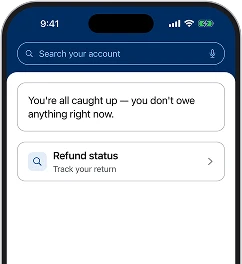
The IRS app’s account screen. Source: IRS.
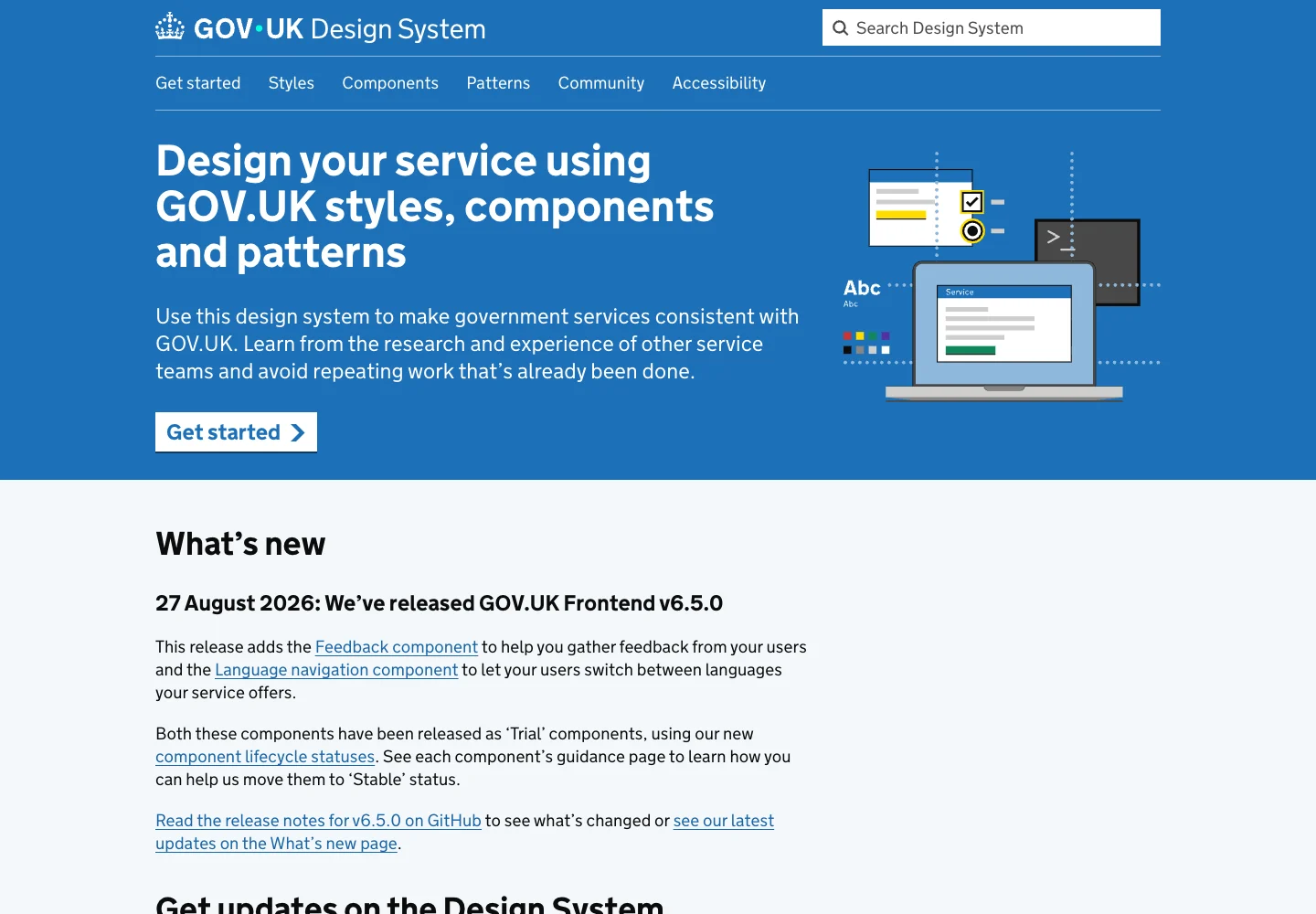
The UK's GOV.UK Design System gives teams shared components and patterns, with a community that can contribute. Its Service Standard asks teams to make new source code open where appropriate. Departments can improve work others have already done on forms, navigation and error messages.
India has OpenForge for government software collaboration, and open-source civic platforms such as DIGIT. I'd like someone who cares about a problem to be able to find it, meet the responsible team and understand how to contribute.
LET US HELP
A website may depend on old records, several departments, vendor contracts and a physical process. A 2024 CAG audit of Uttarakhand's financial management system identified deficiencies in documentation and testing, along with vendor-dependency risks. It doesn't establish the cause of my MCA problem, but shows how organisational decisions can make software difficult to improve.
Someone needs responsibility for the complete journey. Otherwise, every team could finish its assigned work and still leave the citizen stuck. The person using the service shouldn't have to work out which team owns the failure.
AI makes it easier for more people to investigate, build and test ideas. One MCA user reported using Claude to investigate an attachment error and finding a filename workaround. I can't verify their explanation of the system, but they reported being able to move forward.
I'd be wary of adding a chatbot to a process nobody has made understandable yet. If my application fails, I need to know how to recover. A friendlier explanation of the same loop would be quite an achievement in the wrong direction.
I'd like government teams to make participation practical and FUN:
-
Publish specific problems with a route to a pilot. Provide test data, access to users and staff, and a team that can approve changes.
-
Bring product and design people into the service. Fellowships, secondments and defined pro bono projects could include research, accessibility and process design alongside engineering.
-
Open appropriate code and shared components. Publish documentation, a backlog and contribution instructions, with maintainers reviewing changes and citizen information kept private.
-
Budget for adoption and maintenance. People may contribute because they care. The government should fund the work a service comes to rely on after volunteers return to their day jobs.
But we can start though
Some useful work can start while those relationships develop:
-
Clearer guides to services and resources. Explain eligibility, required documents and where to apply, linking to official sources and showing when the guidance was checked. Startup resources for founders are an area I'm already building in, so stay tuned.
-
A public record of problems and fixes. Show whether others are stuck at the same step, whether the issue is acknowledged, and whether a fix works. Connect duplicate reports without exposing personal information.
-
Civic reporting with follow-through. Help people report broken walking paths, unsafe crossings and inaccessible public spaces to the responsible authority, then track whether the repair happened.
The public tracker is something I could see myself building. I might even build it, if people would want to use it. There are already projects like bribes.fyi trying to do useful civic work. In August, ThePrint reported that its builders voluntarily paused it while seeking legal and financial help. They said the pause was precautionary, rather than a response to a complaint. Builders need support around the work, too.
Clear documentation, stable links, structured information and documented APIs would also help authorised AI agents find services, prepare applications or check status. Access should require consent, with confirmation before payments or submissions and an accessible way for people to use the service directly.
Build and Let Build (for Bharat)
For those of us who build, design or research products, there is a place to start too. Pick one service journey. Talk to the people using it and the staff handling it. Document where it breaks, propose a small improvement, and measure whether someone can complete the task more easily. A clearer set of instructions or a reliable recovery path could be useful work. Use this as a way to practice your skills.
I want more initiatives like the hackathon, with government teams able to continue working with the people they bring together.
Let them loose! Let them build.
Better services would help the government anyway: fewer repeated questions, clearer evidence of failures and more people able to access benefits or meet their obligations.
To the people running government digital services: publish the problems you want solved and invite builders to work with your teams. Give contributors access to users, a safe place to test and a clear process for reviewing their work. Fund promising pilots and the maintenance they need. Let citizens see what changed and whether it helped.
The current generation (and the next) are not forgiving, especially when it comes to digital. We have expectations.
Build and let Build.